
Floor Screed Calculator for Dry Mix and Bags
Calculate screed area, dry-mix weight and whole bags from floor size, thickness and consumption rate.
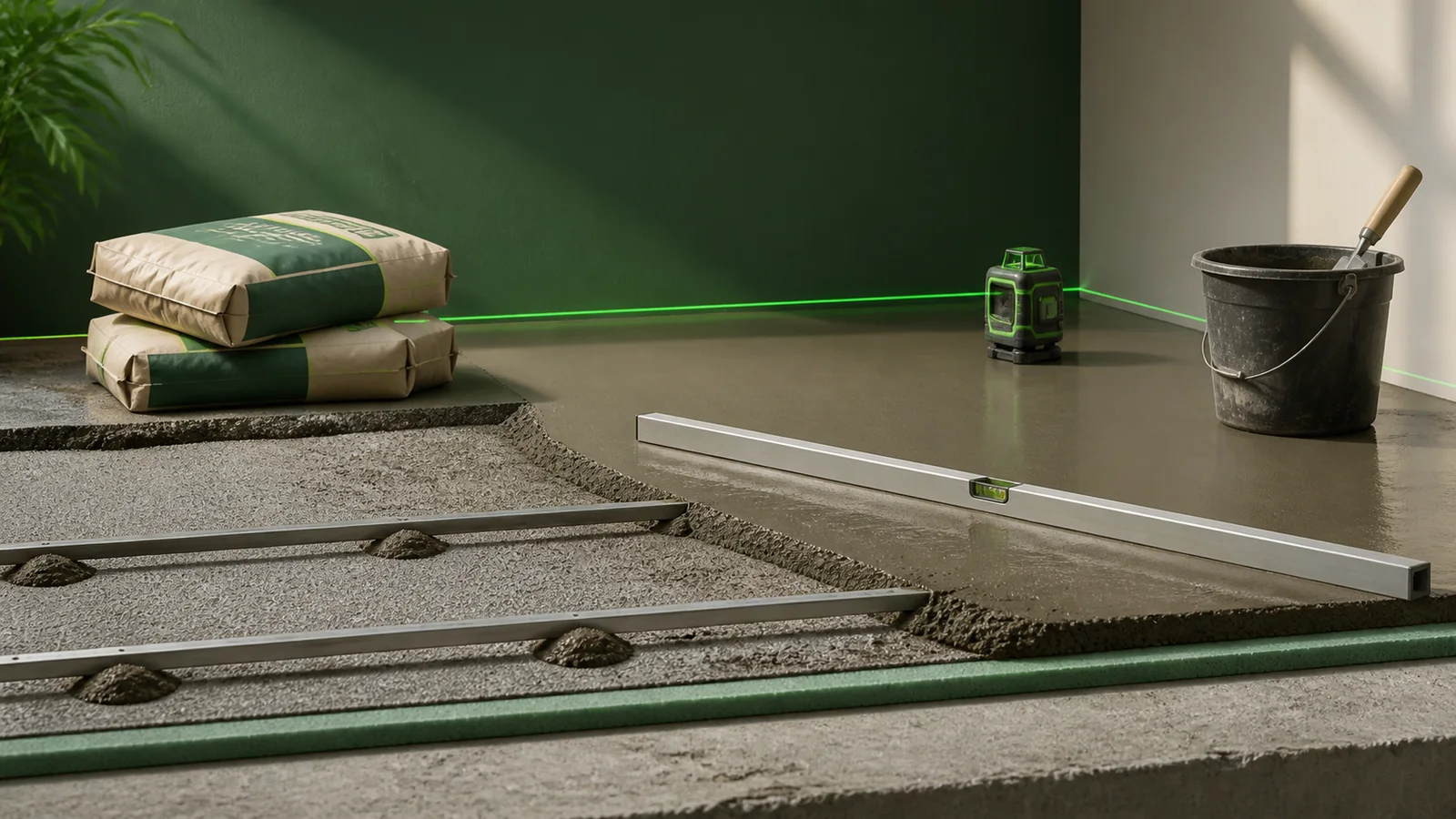
Calculate screed area, dry-mix weight and whole bags from floor size, thickness and consumption rate.
Measurements that produce a useful result
Measure the finished room or surface rather than relying only on a drawing. Check the longest and shortest dimensions, write down the raw figures and keep every input in the unit shown beside the field. Product coverage, pack size and consumption vary, so replace the example values with the numbers printed on the material you intend to buy.
Take level readings across the floor and base the input on average thickness, not only the deepest point. Divide stepped areas into separate zones.
- Sketch the area and split irregular shapes into rectangles.
- Measure twice before rounding any dimension.
- Keep openings, fixed furniture and thresholds as separate notes.
- Enter product data from the current package or technical sheet.
How the calculator handles the numbers
Floor area is multiplied by average thickness and label consumption per square metre per millimetre. The resulting dry mass is rounded to whole bags.
The calculation keeps full precision through the intermediate steps. Waste is added only after the base area, length or material mass has been found. Quantities sold as packs, rolls, bags or pieces are rounded up at the end because a fraction of a sealed package normally cannot be ordered.
Reading the answer before you buy
Check the product’s minimum and maximum application thickness. A thick build-up may require another system or more than one operation.
Use the exact area, length or weight to compare products. Use the rounded package figure as the starting point for an order. A result is not a promise that every offcut can be reused. Room shape, direction of installation, damaged pieces and batch matching can all change the practical quantity.
A sensible ordering check
Primer, edge strip, reinforcement and movement joints are not included in the bag count and must be planned separately.
Confirm that all packs come from a compatible batch when colour, texture or calibration matters. Check delivery access and storage conditions before ordering heavy or moisture-sensitive materials. If the work will be completed in stages, keep enough matching material for the last section and for a small future repair.
Common mistakes worth avoiding
Do not mix centimetres with metres, do not round every measurement upward, and do not copy a generic coverage figure when the chosen product gives a different value. Measure connected rooms separately if the layout or material direction changes. For structural, electrical or code-dependent decisions, use the result only for early planning and ask a qualified local professional to review the project.
What to verify on the actual job
Before payment, walk through the job in the same order that the material will be installed. Look for tapered walls, raised thresholds, service boxes, damp areas and places where a full piece cannot be used. Mark the first row or reference line and check the final visible strip. This short site check often explains more than adding a large percentage without knowing where the extra material will go.
Questions people ask before ordering
Should every opening be subtracted?
Not always. Small openings may save less material than the surrounding cuts consume. Subtract an opening only when it genuinely reduces the pieces or packages you need.
How much waste should I enter?
Simple straight layouts often need a smaller allowance than diagonal patterns, narrow rooms or surfaces with many corners. Start with the suggested value, then adjust it to the actual layout.
Can I use the result as a purchase order?
Treat it as a checked planning quantity. Compare it with the package label, the installation instructions and the conditions on site before placing the order.